
Author: Eluya, Business Strategy Consultant / Systematic AI Application / Pokémon Collector & Enthusiast
Many Pokémon TCG beginners, players, or collectors often ask when first encountering different language versions:
- What are the differences between Japanese, English, Traditional Chinese, Simplified Chinese, and Korean versions?
- Which version is the easiest to grade a PSA 10?
- Which version has the highest collection value?
- Which version is the most worth investing in?
- Are the guaranteed pull-rate mechanisms different?
In fact, different language versions of Pokémon cards vary significantly in print quality, market circulation, collecting culture, and appreciation potential. In recent years, with the release of popular sets like Pokémon 151 and Terastal Festival, these market differences across languages have become even more pronounced.
The guaranteed pull-rate mechanisms will be deeply analyzed in a separate upcoming article. This article will focus primarily on the market differences and collection directions of each language version.
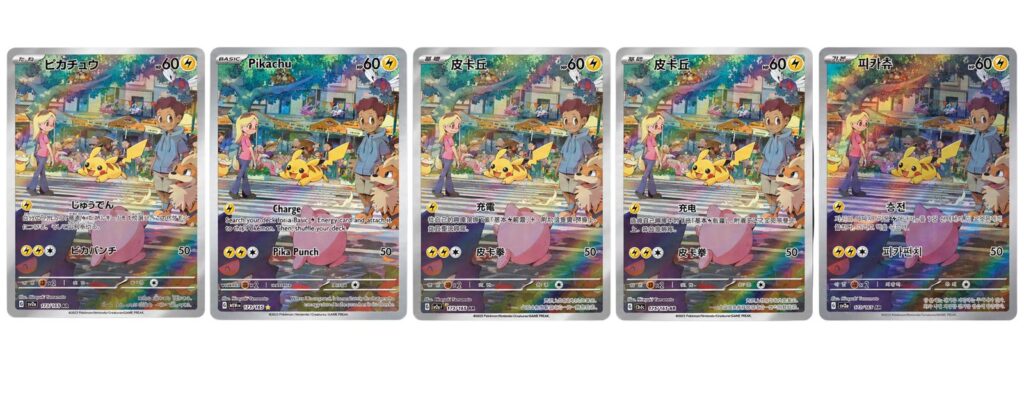
Comparison of Pokémon 151 Pikachu AR Across Different Language Versions (Some images have been enhanced using AI upscaling, which may result in minor visual differences from the physical cards. Image content is for version and market comparison reference only.)
Quick Summary:
If you are looking for long-term collecting, the Japanese version remains one of the most stable choices.
If you are pursuing international markets and premium pricing on high-grade cards, the English version still holds the advantage.
If you are a player in Taiwan, Hong Kong, or Macau, the Traditional Chinese version offers distinct advantages in pricing and gameplay circulation.
If you want to enter the market at a low cost and monitor emerging markets, the Simplified Chinese version is worth paying attention to.
If you want to enter the market at a low cost, you can further compare the Simplified Chinese, Traditional Chinese, and Korean versions based on your collection goals.